


GTT: The Toll Road Inside the LNG Trade

GTT: The Toll Road Inside the LNG Trade


Most toll roads are easy to see. GTT’s sits inside the hull of a ship.
Overview: an essential link in seaborne gas
Natural gas is playing an increasingly important role as countries attempt to balance three competing needs: energy security, affordability and the transition from higher-carbon fossil fuels to lower emissions. Yet gas is often produced far from where it is consumed.
The disruption of Russian pipeline supplies to Europe, sanctions and wider geopolitical tension have accelerated the search for more diverse sources of energy. At the same time, the growth of U.S. shale gas and new export capacity in the United States and Qatar is shifting supply towards regions that cannot reach customers by pipeline.
The change in the gas supply chain makes ocean-going transport increasingly important. To travel by sea, natural gas must first be cooled to around -163°C, reducing its volume so it can be carried as liquefied natural gas, or LNG. It must then remain safely contained at cryogenic temperatures throughout the voyage. This critical step is where Gaztransport & Technigaz, better known as GTT, becomes indispensable.
The catalyst for growth: more gas travelling further by sea
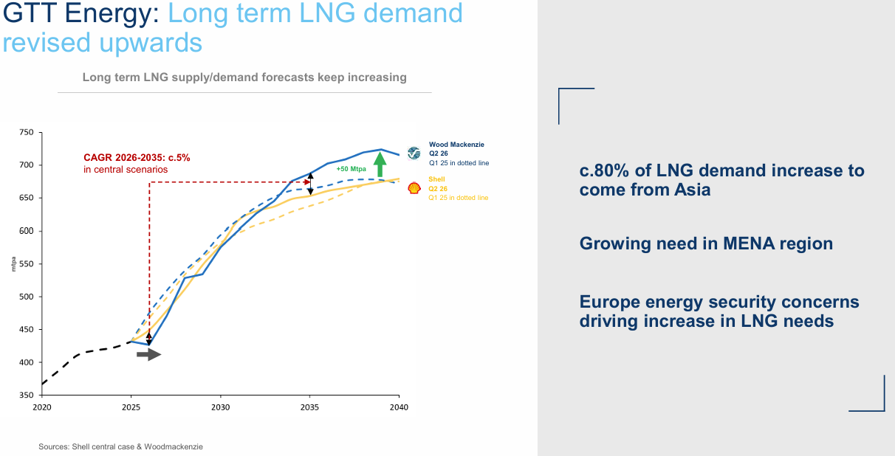
The LNG market is growing, and its trading routes are being redrawn. The International Energy Agency expects around 300 billion cubic meters a year of new LNG export capacity to be added worldwide by 2030, led primarily by the United States and Qatar. This expansion should improve supply security and make gas more accessible to price-sensitive importing markets.
For GTT, distance matters as much as volume. A cargo travelling from the U.S. Gulf Coast to Asia ties up a vessel for longer than one moving from the Middle East. Longer routes therefore require more ships to move the same annual quantity of gas. The substitution fixed pipelines for flexible seaborne LNG reinforces this effect. Europe’s rapid installation of floating import capacity after the reduction in Russian pipeline gas showed how quickly maritime infrastructure can become strategically important.
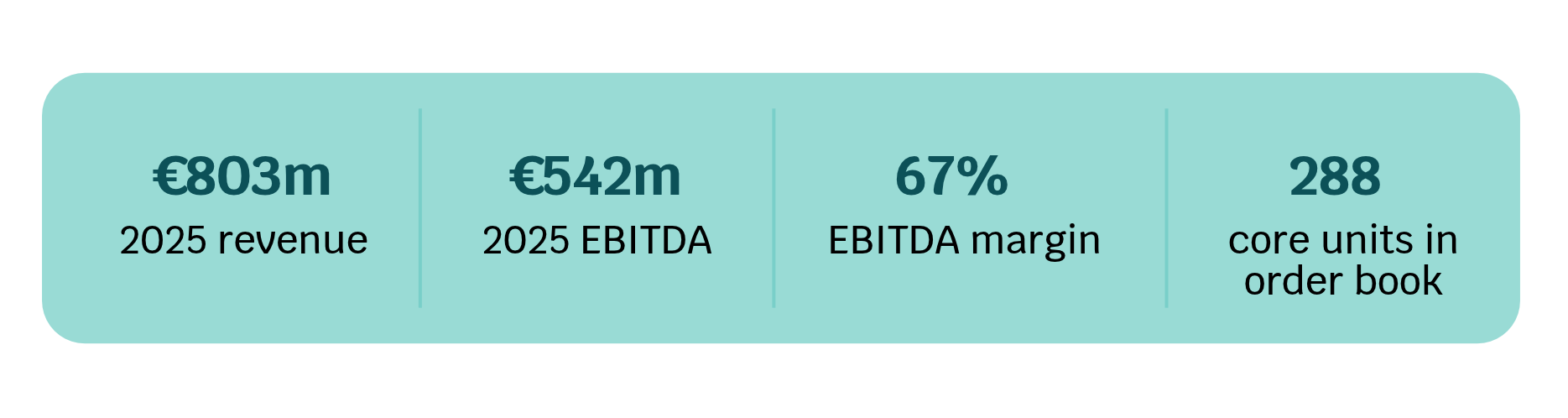
GTT is exposed to the capital-investment phase of this cycle rather than to the gas price itself. New liquefaction projects, long-term supply contracts and new carrier orders are the important links. In 2025, final investment decisions for new liquefaction capacity reached a record 84 million tonnes per annum. GTT ended the year with 288 core units in its order book, including 261 LNG carriers, providing substantial visibility into future royalty revenue.
The secret to enduring growth: a near-monopoly hidden in the hull
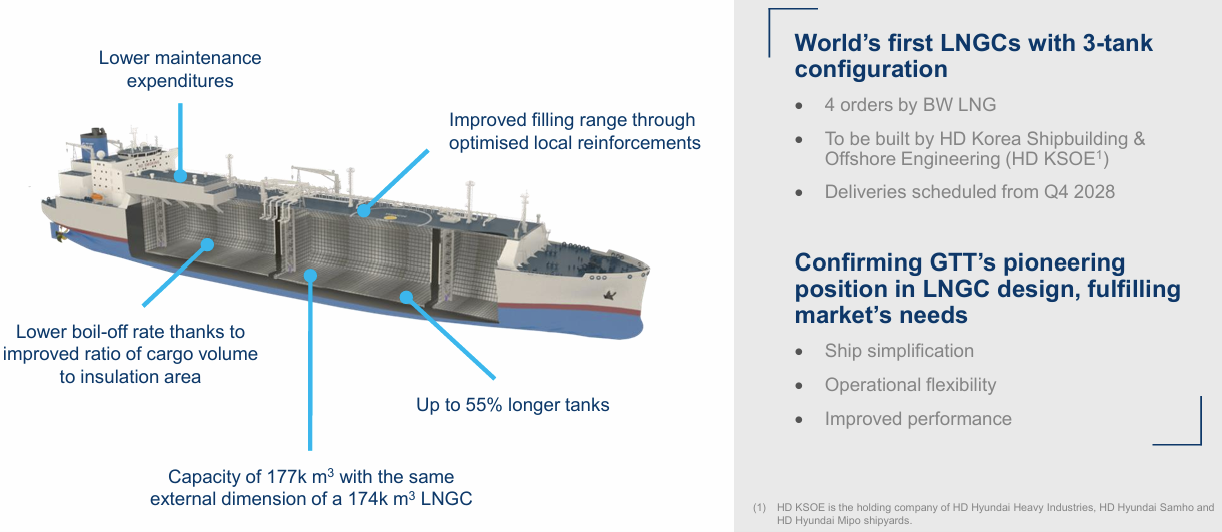
GTT does not build ships, manufacture steel hulls or own shipyards. Instead, it designs the membrane-containment systems that sit inside LNG carriers and licenses that intellectual property to qualified shipyards. Its technologies combine a thin metallic membrane, insulation and the vessel’s structure to keep LNG safely contained at cryogenic temperature while maximising cargo capacity and controlling boil-off.
In its core LNG-carrier market, GTT is effectively a monopoly. Its systems are used across the majority of modern large LNG carriers. GTT states that all 575 large LNG carriers ordered worldwide between 2016 and 2025 use, or will use, GTT containment systems. This position has been built over more than 60 years of operating experience, approval by classification societies, close relationships with shipyards and shipowners, and an active portfolio of 3,637 patents at the end of 2025.
The moat is strengthened by the consequences of failure. The containment system represents a small part of the total cost of a carrier but is critical to the vessel’s safety and economic performance. Shipowners, shipyards, charterers, insurers and classification societies have little incentive to experiment with an unproven alternative whose weaknesses might emerge only after years at sea. Reliability, accumulated data and a long operating record therefore matter more than the lowest upfront price.
A licence model with exceptional economics
GTT’s economics are unusual for a business connected to heavy industry. Once a shipyard has been licensed and a vessel design selected, GTT supplies the design, engineering support, approvals, technical assistance and supervision. The shipyard bears the cost of constructing the vessel and sourcing the approved materials. GTT receives royalties as construction milestones are reached.
The result is a capital-light, high-margin model. In 2025, containment systems represented 90% of revenue, while group revenue reached €803 million and EBITDA €542 million, a 67% margin. Free cash flow was €271 million and the proposed dividend rose by 19% to €8.94 per share. The model converts intellectual property and technical know-how into cash without requiring GTT to finance shipyards, vessels or large manufacturing plants.
This is the attraction of the franchise. A relatively small engineering company occupies a bottleneck within a much larger LNG value chain. Every new export terminal may require a fleet of carriers; every carrier requires a containment system; and in the core market, that system is overwhelmingly likely to be based on GTT technology.
Further upside: LNG as a marine fuel
The core investment case does not depend on LNG becoming a dominant shipping fuel, but that market does provide meaningful optionality. International shipping still relies heavily on oil-based fuels. As regulation tightens and shipowners seek practical ways to lower local pollutants and carbon emissions, LNG can offer an immediately available alternative for large ocean-going vessels, particularly container ships.
GTT adapts its membrane technology for fuel tanks installed inside commercial vessels. In 2025, 18 LNG-fuel tanks were ordered for container ships and the LNG-as-fuel order book stood at 48 units. The opportunity could become much larger if shipowners increasingly switch from heavy fuel oil.
Why we still hold: scarcity value with a long runway
GTT combines several characteristics that are rarely found together: near-monopoly positioning in an essential technology, powerful structural demand, a capital-light licensing model, high margins, strong cash conversion and a shareholder-friendly distribution policy. The reshaping of global gas markets provides the volume runway; the growing distance between new supply and demand centres increases shipping intensity; and GTT’s embedded role in vessel design allows it to capture value without owning the heavy assets.
However, there are risks. LNG-carrier orders are cyclical and sensitive to project delays, interest rates and geopolitics. A restoration of Russian pipeline flows could reduce some of Europe’s urgency, while prolonged low gas prices might weaken investment in new liquefaction capacity. GTT must also prove that acquisitions and adjacent technologies can earn acceptable returns without diluting the quality of the core franchise.
Nevertheless, the central insight is simple: as more gas travels by sea, the world needs more cryogenic containment. GTT has turned that need into an intellectual-property toll road with almost no concrete of its own. It is a monopoly hidden inside the hull, and one of the clearest examples of how a small company can control a critical point in a vast global value chain.
Disclaimer
GTT is a current holding in our strategies. For professional investors only. For informational and educational purposes only. References to a specific company are included to illustrate our research process and do not constitute investment advice or a recommendation to buy or sell any security. All investing involves risk of loss.
Dundas Global Investors is the trading name of Dundas Partners LLP. Dundas Partners LLP is authorised and regulated by the Financial Conduct Authority (FCA) in the UK, the Securities and Exchange Commission (SEC) in the USA, and the Australian Securities and Investment Commission (ASIC) in Australia. The Authorised Corporate Director for the Heriot Investment Funds is Waystone Management (UK) Limited which is also authorised and regulated by the Financial Conduct Authority.
Dundas Partners LLP provides investment management services to clients in the UK, USA, Australia, and New Zealand. In this communication Dundas Partners LLP may be referred to as DGI, Dundas or Dundas Global Investors.
This document is a financial promotion and intended for professional, eligible counterparty and institutional investors only. The information presented is for the intended recipient(s) and is not to be shared or disseminated without our prior approval. This material has not been prepared for retail clients.
Investors are reminded that the price of shares and the income derived from them is not guaranteed and may go down as well as up. Past performance is not a reliable indicator of future results. This document contains information produced by Dundas and sourced from others where stated. The images used are for illustrative purposes only. The views expressed are those of Dundas and are based on current market conditions. They do not constitute investment advice or a recommendation to buy any security which has been highlighted in this material. Although this communication is based on sources of information that Dundas believes to be reliable, no guarantee is given as to its accuracy or completeness.
In relation to FCA handbook ESG 4.3, Dundas does not market these funds as a ‘sustainability product’. Use of any sustainability related terms in describing the characteristics of the strategy, or inclusion of any third-party information which measures sustainability of our portfolios are for information purposes only.
The MSCI® information contained herein: (1) is provided ‘‘as is,’’ (2) is proprietary to MSCI and/or its content providers, (3) may not be used to create any financial instruments or products or any indexes and (4) may not be copied or distributed without MSCI’s express written consent. MSCI disclaims all warranties with respect to the information. Neither MSCI nor its content providers are responsible for any damages or losses arising from any use of this information.
For full information on fund risks and costs and charges, please refer to the Key Investor Information Documents, Annual & Interim Reports, and the Prospectus, which are available on our website (https://www.dundasglobal.com). Recent performance information is also shown on factsheets, available on the website.