


Spend Less, Expect More: Ross Stores and the Selective Consumer

Spend Less, Expect More: Ross Stores and the Selective Consumer


Overview
US consumers entered the fourth quarter under renewed pressure. Sentiment weakened in September following two prior months of softening as concerns about prices and personal finances increased.
Yet Ross Stores’ most recently reported quarter told a different story. For the 13 weeks ended 1 August 2026, sales rose 13% to $6.3 billion, while comparable sales increased 10%, driven primarily by customer traffic by both new customers and greater engagement among existing shoppers.
What explains the apparent disconnect?
Pressure on household budgets does not necessarily mean consumers stop spending. It may instead make them more selective about where they spend and what they expect in return.
That places a greater burden on retailers. When customers are harder to win, a business must give them a clear reason to earn that visit.
A model built for value
As people become less confident about their finances, faced with persistently high prices and wider uncertainty, they are likely to become more selective about discretionary spending, particularly on higher-value, non-essential goods.
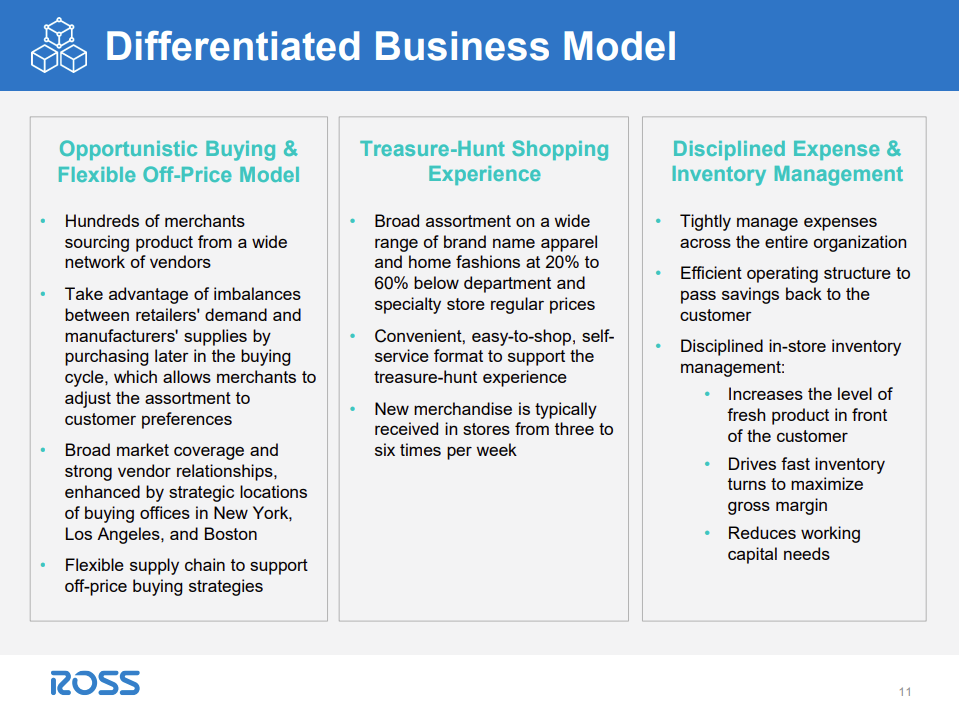
This is where Ross Stores’ proposition becomes relevant. The company operates an off-price model built around recognised brands at discounted prices. Its buyers purchase later in the buying cycle, seeking to take advantage of imbalances between retailers’ demand and manufacturers’ supply. Regular merchandise deliveries and a convenient, self-service format support a “treasure hunt” experience that gives customers a reason to return.
The company’s latest results provide a timely test of that model. This was also highlighted in a recent earnings call, where Jim Conroy, the company’s CEO said:
We're thrilled by not only the underlying growth number, the 10% comp, but the quality of the comp. It's really driven mostly by more transactions. Those transactions are driven by customer capture, both new and regaining lapsed customers.
Ross Stores also opened 47 locations during the second quarter and subsequently, encouraged by progress across new and existing markets, they completed their fiscal 2026 expansion programme and opened a further 51 locations across 17 states during September and October. These comprise 41 Ross Dress for Less stores and 10 dd’s DISCOUNTS locations, bringing the total openings for the year to 115.
The expansion takes the combined estate to approximately 2,377 stores across its two brands. Management believes there is scope to grow to at least 2,900 Ross Dress for Less and 700 dd’s DISCOUNTS locations over time. These are long-term ambitions rather than guarantees, but they provide another indication of management’s confidence in the relevance of the off-price proposition.
As Richard Lietz, Executive Vice President of Property Development, observed:
“...As customers increasingly seek great brands at great prices, Ross’ off-price offering continues to resonate.”
Completing the expansion programme does not, by itself, establish enduring quality. New stores must still attract customers and generate appropriate returns. However, the expansion extends the model’s reach at a time when value appears to be becoming more important to consumers.
Quality through relevance
One company and one quarter cannot represent the wider US consumer or retail sector. Nor do strong quarterly results alone establish enduring business quality. Ross Stores also remains exposed to risks including changes in discretionary spending, competition, tariffs, merchandise availability and the execution of its expansion plans.
Its recent results and completion of the fiscal 2026 store programme nevertheless offer a useful illustration of what quality can look like in practice: a clear customer proposition, disciplined execution and the ability to remain relevant as conditions change. The next test will be whether the enlarged store estate can continue to attract customers and generate appropriate returns over time.
When consumers become more selective, as investors, you should not only ask whether they will keep spending, but what businesses can continue to earn that spend.
Disclaimer
Ross Stores is a current holding in our strategies. For professional investors only. For informational and educational purposes only. References to a specific company are included to illustrate our research process and do not constitute investment advice or a recommendation to buy or sell any security. All investing involves risk of loss.
Dundas Global Investors is the trading name of Dundas Partners LLP. Dundas Partners LLP is authorised and regulated by the Financial Conduct Authority (FCA) in the UK, the Securities and Exchange Commission (SEC) in the USA, and the Australian Securities and Investment Commission (ASIC) in Australia. The Authorised Corporate Director for the Heriot Investment Funds is Waystone Management (UK) Limited which is also authorised and regulated by the Financial Conduct Authority.
Dundas Partners LLP provides investment management services to clients in the UK, USA, Australia, and New Zealand. In this communication Dundas Partners LLP may be referred to as DGI, Dundas or Dundas Global Investors. This document is a financial promotion and intended for professional, eligible counterparty and institutional investors only. The information presented is for the intended recipient(s) and is not to be shared or disseminated without our prior approval. This material has not been prepared for retail clients. Investors are reminded that the price of shares and the income derived from them is not guaranteed and may go down as well as up. Past performance is not a reliable indicator of future results.
This document contains information produced by Dundas and sourced from others where stated. The images used are for illustrative purposes only. The views expressed are those of Dundas and are based on current market conditions. They do not constitute investment advice or a recommendation to buy any security which has been highlighted in this material. Although this communication is based on sources of information that Dundas believes to be reliable, no guarantee is given as to its accuracy or completeness.
In relation to FCA handbook ESG 4.3, Dundas does not market these funds as a ‘sustainability product’. Use of any sustainability related terms in describing the characteristics of the strategy, or inclusion of any third-party information which measures sustainability of our portfolios are for information purposes only.The MSCI® information contained herein: (1) is provided ‘‘as is,’’ (2) is proprietary to MSCI and/or its content providers, (3) may not be used to create any financial instruments or products or any indexes and (4) may not be copied or distributed without MSCI’s express written consent. MSCI disclaims all warranties with respect to the information. Neither MSCI nor its content providers are responsible for any damages or losses arising from any use of this information.
For full information on fund risks and costs and charges, please refer to the Key Investor Information Documents, Annual & Interim Reports, and the Prospectus, which are available on our website (https://www.dundasglobal.com). Recent performance information is also shown on factsheets, available on the website.